
Die casting
Advanced Solutions in Aluminium Die Casting

Aluminium Die Casting
Aluminium die casting is a high-efficiency process that injects molten alloy into precision molds under extreme pressure. Compared to sand or investment casting, Aluminium die casting is the preferred method for producing complex, high-volume components that require a balance of lightweight design and superior mechanical strength.
At CTT, we specialize in professional Aluminium Die Casting services for diverse technical components. By integrating specialized stress-management and anodizing techniques, we ensure that every components we deliver features a high-quality surface treatment with consistent dimensional stability.
What is Precision Aluminium Die Casting? Defining High-Performance Manufacturing
Precision Aluminium Die Casting is an advanced manufacturing process that injects molten alloy into precision-engineered molds under extreme high pressure. Unlike conventional casting, this high-tech method focuses on achieving near-net shapes with tight geometric accuracy.
At CTT, we elevate this technology by combining aluminum die casting with specialized aluminum CNC machining, ensuring that even the most complex optical housings meet strict aerospace-grade tolerances and superior surface stability.
The primary advantages of die casting lie in its exceptional repeatability and long-term material stability. In high-volume industrial production, non-ferrous alloys are the most widely used materials, with a primary focus on:
ADC12 / A383: Excellent fluidity and mechanical strength for complex structural enclosures.
A380 / A360: Superior corrosion resistance and thermal conductivity for demanding environments.
Selecting the Right Die Casting Alloy: A Comprehensive Guide to Aluminum, Zinc, and Magnesium
- In the world of precision manufacturing, selecting the optimal alloy is critical to balancing performance, weight, and cost. At CTT, we specialize in high-pressure die casting across three primary material categories, each offering unique advantages for specialized industries like cycling, automotive, and electronics.
- 1. Aluminum Alloys: The Industry Standard (approx. 80% of Market Share)
- “Aluminium die casting: The Premier Choice for High-Tech Industries.”
- Key Advantages: Excellent strength-to-weight ratio, superior corrosion resistance, high dimensional stability, and outstanding thermal/electrical conductivity.
- Common Grades: * ADC12: The most versatile and widely used grade.
- A380: Offers the best balance of physical and mechanical properties.
- A360: Preferred for applications requiring high pressure tightness and fluidity.
- Applications: Bicycle frame components, derailleur housings, high-density heatsinks, and engine blocks.
- 2. Zinc Alloys: Precision for Complex Miniatures
- When a project demands intricate detail and superior surface finishing, Zinc is the go-to choice.
- Key Advantages: Lowest melting point (extending tool life), exceptional fluidity for ultra-thin wall sections, and the best substrate for decorative finishes like electroplating or powder coating.
- Common Grades: * Zamak 3: The industry standard for balance and stability.
- Zamak 5: Higher copper content for increased hardness and strength.
- Applications: High-end hardware, electronic enclosures, precision gears, and intricate decorative accessories.
- 3. Magnesium Alloys: The Ultimate Choice for Lightweighting
- “In the race for ultimate lightweight performance, Magnesium is the undisputed star material.”
- Key Advantages: 33% lighter than aluminum, exceptional strength-to-weight ratio, and superior damping (vibration absorption) capabilities.
- Key Challenges: Highly reactive during production (requires specialized safety protocols), higher material costs, and requires advanced surface treatments (anodizing/coating) for corrosion protection.
- Common Grades: AZ91D, AM60B.
- Applications: High-end bicycle suspension fork bottoms, premium laptop chassis, and UAV (Drone) airframes.
Overcoming Surface Challenges in Aluminium Die Casting : CTT’s Turnkey Advantage
Most aluminium die casting parts struggle with surface finishing, but CTT’s Turnkey Manufacturing solutions bridge this gap. Our process begins with expert Mold Design to ensure low porosity in every part, creating a solid foundation for premium finishing.
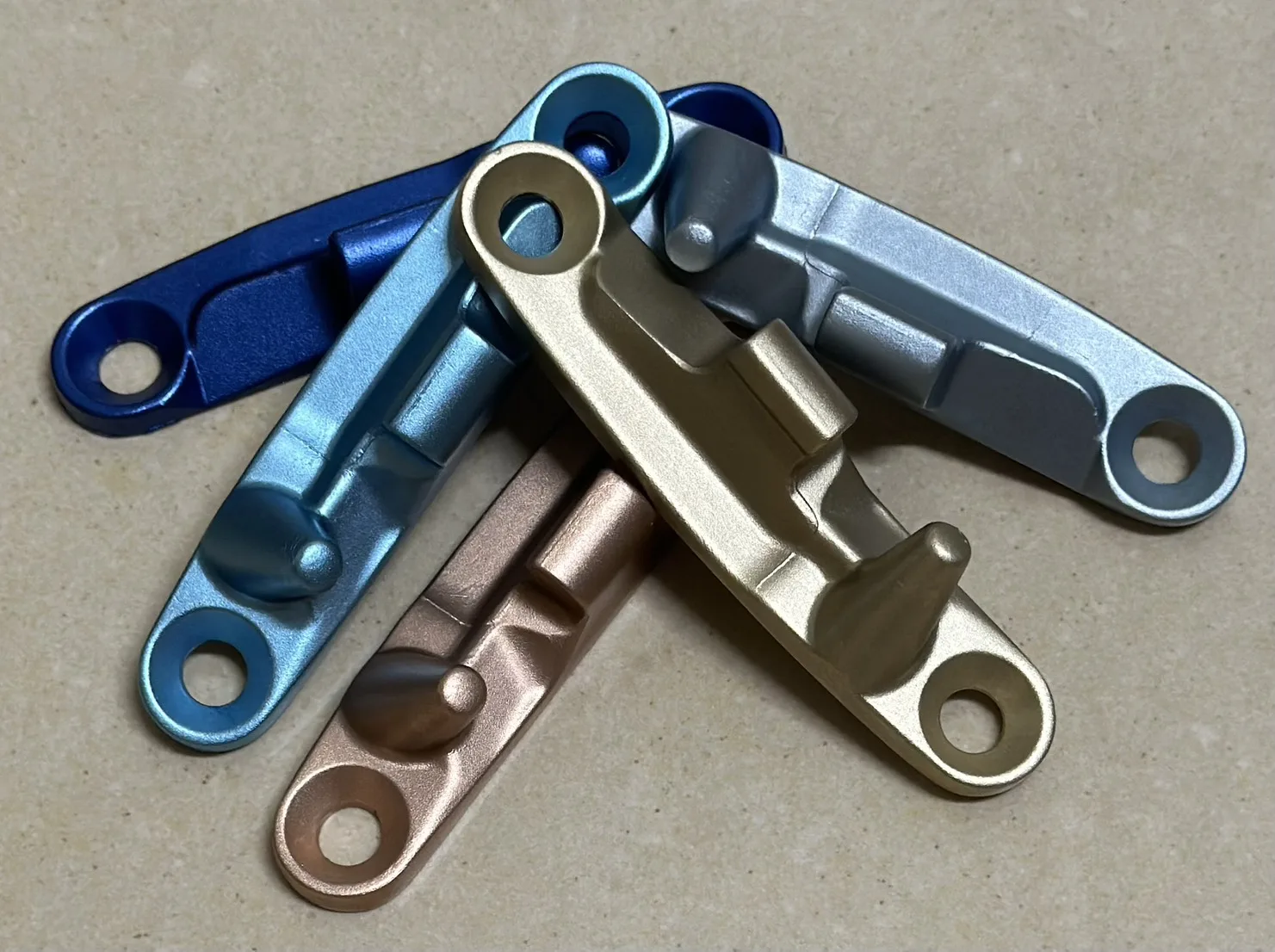
By combining high-pressure casting with precision secondary operations—specifically custom CNC machining—we achieve tight tolerances and superior surface integrity. This integrated approach allows us to deliver high-end anodizing, ranging from aesthetic vibrance to 50μm industrial durability, ensuring your complex components meet elite functional and visual standards.

- Aluminum Alloy
- Stainless Steel
- Steel
- Cast iron
- Copper alloy
- Magnesium alloy
- Nickel-based alloy
These materials and their standard numbers are applied in various industries across different regions. Selecting appropriate materials and processes based on specific requirements and standards can ensure the performance and quality of the products.
Casting is a process where molten metal is poured into a mold and cooled to form the desired shape. Depending on the process and application, casting can be divided into various types, each using different materials. Below are some common casting processes and their respective materials:
- Sand casting
- Die casting
- Investment casting
- Lost-wax casting
- Continuous casting
- Centrifugal casting
- Low-pressure casting
- Lost foam casting
Each casting process has its specific advantages and applications. Choosing the appropriate process and material based on product requirements can maximize production efficiency and product quality.
After the casting process is completed, castings typically require various surface treatments to improve surface quality, corrosion resistance, and other properties. Here are some common casting surface treatment techniques and their applications:
- Anodizing
- Sandblasting
- Vibration & Polishing
- Electroplating
- Spray Coating
- Heat Treatment
- Chemical Treatment
- Electrochemical Polishing
- PVD Coating (Physical Vapor Deposition Coating)
- Chemical Plating
- Black Oxide Coating
- Galvanizing
Each surface treatment technology has its specific applications and advantages. Selecting the appropriate surface treatment method based on product requirements can enhance the performance and extend the lifespan of the product.


