PVD

PVD (Physical Vapor Deposition) is an advanced surface treatment technology used to deposit thin films on substrates. The process involves transforming solid metal or alloy materials into a vapor phase, which is then deposited onto the substrate to form a thin film. PVD treatment enhances the wear resistance, corrosion resistance, and appearance of materials, and is widely applied in fields such as tools, mechanical parts, and decorative coatings. Due to its environmental friendliness and high efficiency, PVD treatment has become one of the essential surface treatment technologies in modern industry.

PVD (Physical Vapor Deposition) technology has a wide range of applications across various industries, mainly including the following areas:
PVD technology is widely applied to metals (such as steel, titanium alloys, aluminum alloys, and stainless steel) and plastic materials after CNC processing, primarily to enhance wear resistance, corrosion resistance, and surface quality. Rubber materials are generally not involved in PVD treatment.
Applications of Electroless Nickel Plating in Various Processes:
PVD technology is primarily used to enhance the surface properties of metals, plastics, and certain special materials. In the aforementioned processes, its application range and effectiveness vary accordingly.
The PVD (Physical Vapor Deposition) process includes several main types, each with its specific process characteristics and application areas:
1. Evaporation Deposition
- Process: Materials are heated to their evaporation point, forming a gas that is then deposited onto the substrate surface.
- Applications:
-Semiconductor Industry: Used for manufacturing integrated circuits and thin-film transistors.
-Optical Coatings: Used for producing reflective layers on optical lenses and displays.
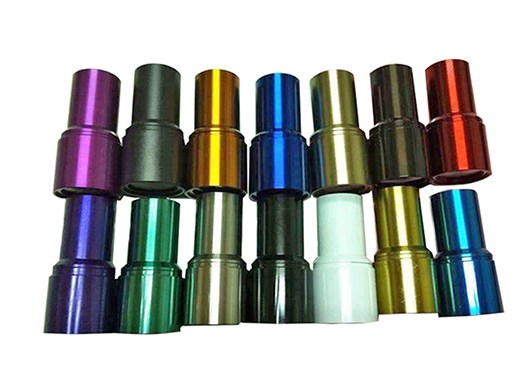
-Decorative Coatings: Used for aesthetic finishing of watches, jewelry, and more.
2. Sputtering Deposition
- Process: High-energy particles are used to bombard a target material, sputtering its atoms onto the substrate surface.
- Applications:
-Tools and Molds: Enhances the wear resistance and corrosion resistance of cutting tools and molds.
-Electronics: Used for coating conductive and insulating layers.
-Magnetic Materials: Used for manufacturing magnetic films and storage devices.
3. Arc Deposition
- Process: Material is evaporated through arc discharge and then deposited onto the substrate.
- Applications:
-Hard Alloys: Wear-resistant coatings for drill bits and cutting tools.
-Automotive Parts: Enhances the durability of automotive engine components.
-Aerospace: Provides high-temperature-resistant coatings on aerospace components.
4. Ion Plating
- Process: The substrate is placed in a vacuum, and ionized gas is used to generate charged particles that are deposited onto the substrate surface.
- Applications:
-Tools: Increases hardness and wear resistance of tools.
-Decorative: Used for watches, jewelry, etc., to add shine and durability.
-Electronic Components: Enhances the performance and lifespan of electronic components.