Managing CTE in Aluminum Optical Housings

Managing CTE in Aluminum Optical Housings
As a premier Optical Housing Manufacturer, we know that system performance often depends on single-micron tolerance precision. Yet, in real-world environments, thermal behavior is the greatest threat to that accuracy. This text explores ‘The CTE Challenge’—how the Coefficient of Thermal Expansion impacts critical optical alignments. Whether we are engineering rugged Machine Vision Camera Enclosures for variable factory floors or the ultra-precise LiDAR Sensor Housings essential for autonomous navigation, controlling material expansion is critical to maintaining focal stability and optical axis alignment. The following article presents ‘The CTT Integrated Solution’ to this fundamental physical problem”.
Thermal Deformation Control for Aluminum Optical Housings
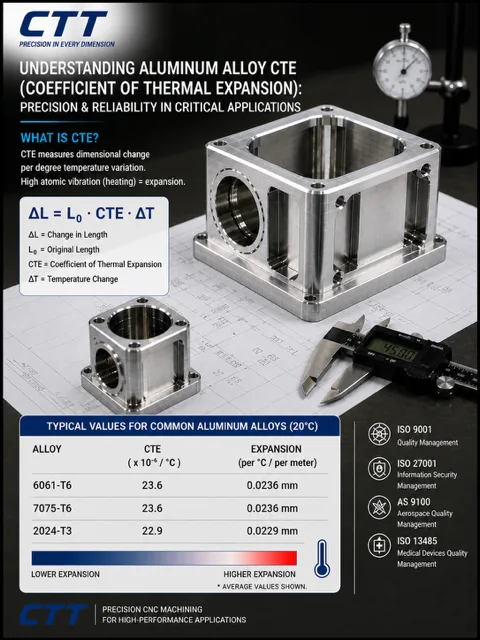
In precision machining and material science, aluminum’s Coefficient of Thermal Expansion (CTE) refers to its linear thermal expansion coefficient. This metric is critical in the manufacturing of optical housings, as aluminum undergoes microscopic dimensional displacements in response to ambient temperature changes, thereby impacting the focusing accuracy of the optical system.
Why is the CTE of aluminum Critical for Optical Housings?
Aluminum alloys are the preferred choice for Aluminium Die Casting due to their excellent strength-to-weight ratio. However, the CTE of aluminum is approximately 23 x 10⁻⁶ / °C (at 20°C). This means that as environmental temperatures fluctuate, the material will expand or contract.
For Optical Housings used in aerospace sensors or machine vision systems, even a displacement of a few micrometers (μm) can lead to focal shifts or optical axis misalignment. Therefore, managing the CTE of aluminum is not just about material selection; it is a matter of precise process control.
How CTT Optimizes Dimensional Stability Through Integrated Manufacturing
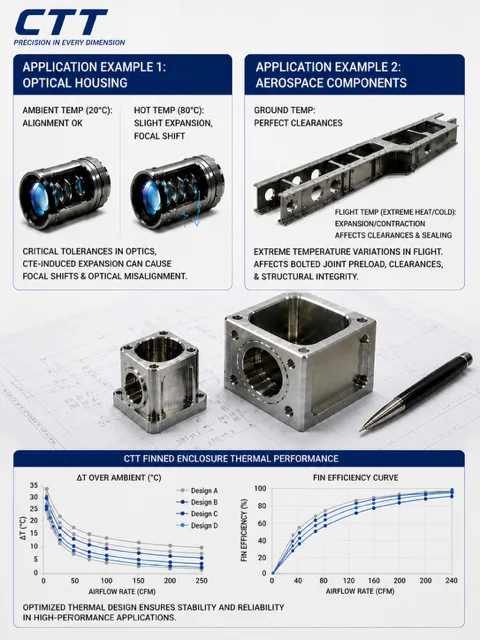
As an expert in integrating die casting and CNC processes, CTT provides Turnkey Manufacturing solutions that address thermal expansion at the source:
| Advanced Mold Design for Uniform Density | Precision begins with the tool. By utilizing high-pressure Aluminium Die Casting with advanced mold flow simulations, we ensure low porosity and a dense internal structure. A uniform material grain structure minimizes irregular deformation when the part is subjected to thermal stress. |
|---|---|
| Stress Relief and Precision CNC Machining | Before proceeding to the final stages of CNC machining aluminum, we perform specialized stress-relief processes on complex Optical Housings. This ensures that the components maintain their dimensional integrity and do not warp when the CTE of aluminum interacts with residual machining stresses. |
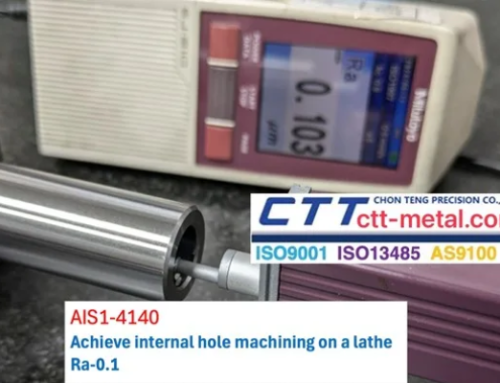
| Surface Integrity and Thermal Management | We strictly control the surface roughness Ra during the machining stage. This precision is vital not only for aesthetics but also for ensuring consistent anodizing quality. A stable surface finish aids in efficient heat dissipation, helping to keep the operating temperature—and thus the thermal expansion—within a controlled range. |
The CTT Advantage: Your Expert in Integrated Solutions with aluminum optical housing
Managing the CTE of aluminum in high-performance enclosures requires decades of metallurgical expertise. CTT provides a decisive advantage for engineers facing these challenges: